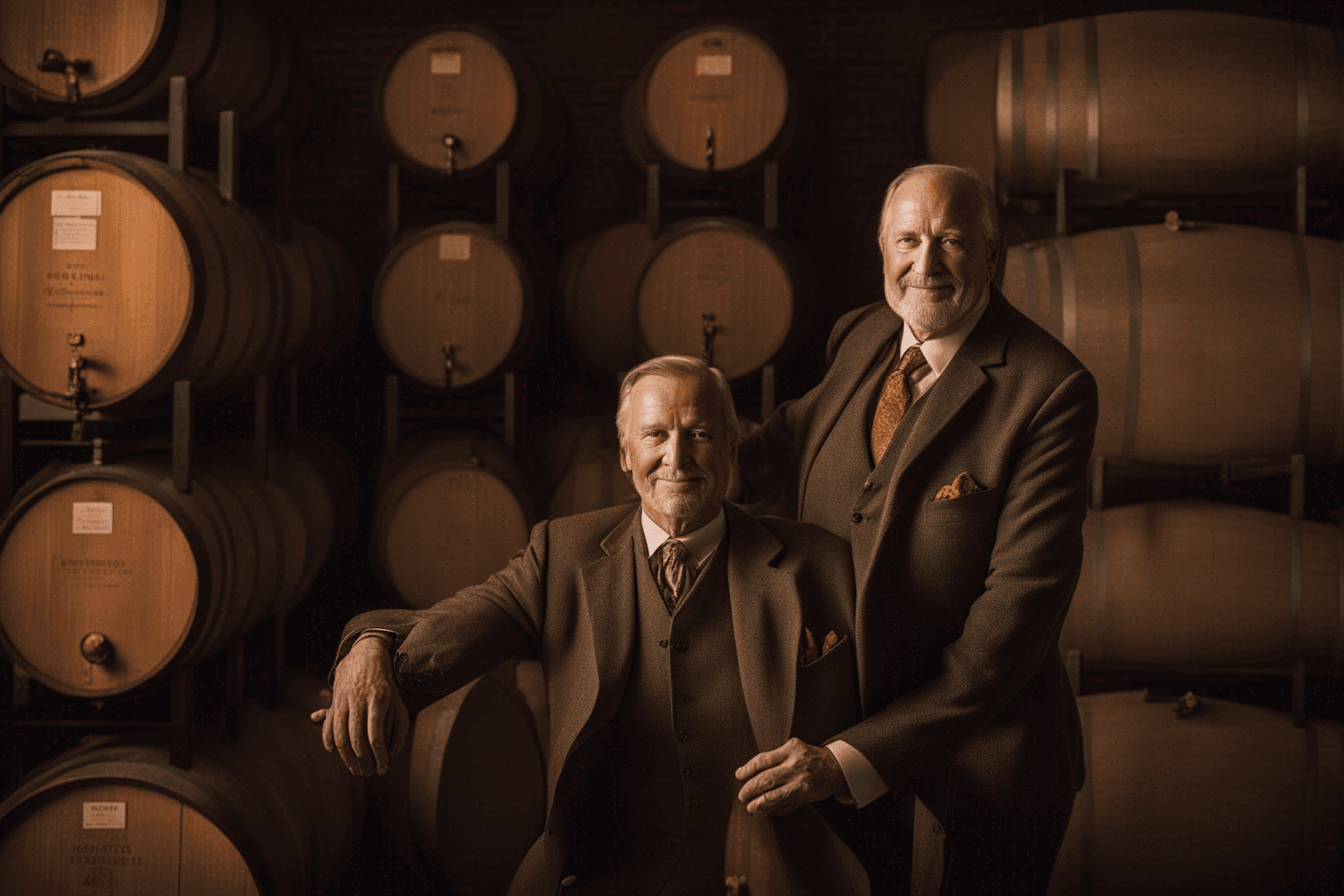
The Quiet Revolution: Four Roses' Brent Elliott on 10 Recipes and Infinite Patience
Four Roses' Master Distiller on managing 10 bourbon recipes, the OBSV vs. OESV debate, and why limited releases aren't always the best bottles.

“People ask me which recipe is best. That’s like asking which child is your favorite. The answer changes depending on the day—and what you’re pairing it with.”
Brent Elliott has been Master Distiller at Four Roses since 2015, inheriting the role from the legendary Jim Rutledge after years of apprenticeship. Unlike most bourbon distilleries that make one recipe and call it a day, Four Roses produces 10 distinct bourbons—two mashbills combined with five proprietary yeast strains. Managing that complexity requires equal parts science, art, and patience. Elliott has all three.
I met him at Four Roses’ newly renovated Cox’s Creek campus to talk about recipes, barrel selection, and why limited releases might be missing the point.
The Conversation
How do you keep track of 10 different bourbon recipes?
Very carefully. We have two mashbills—one with 60% corn, 35% rye, and 5% malted barley, which we call our high-rye mashbill. The other is 75% corn, 20% rye, and 5% malted barley. Then we have five yeast strains—V, K, O, Q, and F—each producing different flavor profiles during fermentation. Combine those and you get 10 distinct recipes. We track every barrel by recipe code: OBSV, OESQ, OESK, and so on. The first letter is always O for Four Roses. The second indicates the mashbill. The third is our proprietary designation. The fourth is the yeast strain.
Do you have a favorite recipe?
I’m partial to OBSV—the high-rye mashbill with our V yeast. It’s got this beautiful balance of spice and fruit. Lots of cinnamon, some red berry notes, creamy mouthfeel. But OESV is a close second. The lower rye content makes it softer, more approachable. Both use the V yeast, which is our fruitiest strain. If I’m being honest, most of my favorite barrels come from V or K fermentations.
Four Roses is known for being incredibly smooth. What’s the secret?
There’s no single secret—it’s a combination of factors. Our low-entry proof helps. We go into the barrel at 120 proof, which is lower than most distilleries. That means less harsh ethanol extraction from the wood. Our single-story warehouses also help. Temperature swings are gentler than in multi-story rickhouses, so you get smoother maturation. And our yeast strains tend to produce cleaner fermentations with fewer harsh congeners. It all adds up.
How do you select barrels for Single Barrel vs. Small Batch Select?
Single Barrel is all about finding barrels that are complete on their own—usually OBSV or OESK that’s 8-9 years old. We taste through hundreds of barrels and pull the ones that have the right balance of sweetness, spice, and oak. Small Batch Select is different. That’s where I get to play blender. We’re pulling barrels from all 10 recipes, different ages, different warehouse locations, and marrying them into something greater than the sum of the parts. It’s a 104-proof blend that showcases the full range of what Four Roses can do.
How do you balance limited releases with core range quality?
The core range always comes first. Always. Limited releases are fun—they let us experiment with age, proof, and recipe combinations—but if our Small Batch and Single Barrel aren’t exceptional, none of the rest matters. I see too many distilleries chasing hype with limited releases while their core products suffer. That’s backwards. Your everyday bourbon should be the best representation of your house style. Limited releases are the bonus, not the foundation.
Do you think the bourbon industry focuses too much on limited releases?
Absolutely. The secondary market has warped people’s perception of value. A bottle that retails for $150 and flips for $1,000 isn’t necessarily better than a $40 bottle you can find on any shelf. It’s just rarer. Rarity and quality aren’t the same thing. Some of the best bourbon I’ve ever tasted was from our standard Small Batch barrels. No fancy label, no hype, just excellent whiskey.
You recently renovated the Cox’s Creek warehouse campus. What changed?
We expanded our barrel storage capacity and upgraded our tasting lab. Cox’s Creek is where we do most of our barrel selection, so having a state-of-the-art facility there made sense. We also improved climate control in some of the warehouses—not to artificially age the bourbon, but to protect against extreme temperature swings. Kentucky summers are brutal, and we want consistent maturation.
What’s the biggest challenge of being a Master Distiller?
Patience. Everything in bourbon happens slowly. A decision I make today won’t show results for 5, 8, 10 years. You have to think long-term while also managing today’s production. And you’re constantly balancing innovation with consistency. People expect Four Roses to taste a certain way, but they also want something new and exciting. Finding that balance is the job.
What’s the most underrated Four Roses expression?
The standard Yellow Label Small Batch. It’s 90 proof, affordable, and available everywhere. People overlook it because it’s not allocated or high-proof, but it’s a masterclass in blending. Four recipes—OBSK, OESK, OBSO, OESO—married into a balanced, approachable bourbon. If you’re new to Four Roses, start there. If you’re a veteran, revisit it. You’ll be surprised.
What are you most proud of from your time as Master Distiller?
Maintaining the quality Jim Rutledge built while also pushing Four Roses forward. Jim left big shoes to fill. My goal was never to replace him—that’s impossible—but to honor his legacy by making the best bourbon I possibly can. Every barrel, every blend, every release. That’s the standard.
After our conversation, Elliott walked me through rows of barrels at Cox’s Creek, pulling samples from different recipes and explaining the subtle differences. For someone managing 10 bourbons simultaneously, he never seemed rushed or overwhelmed—just deeply engaged with every barrel, every flavor, every decision. That’s the quiet revolution at Four Roses: complexity managed with patience, innovation grounded in tradition, and a Master Distiller who cares more about the liquid than the hype.